_edited.png)
Physiotherapy and Taping
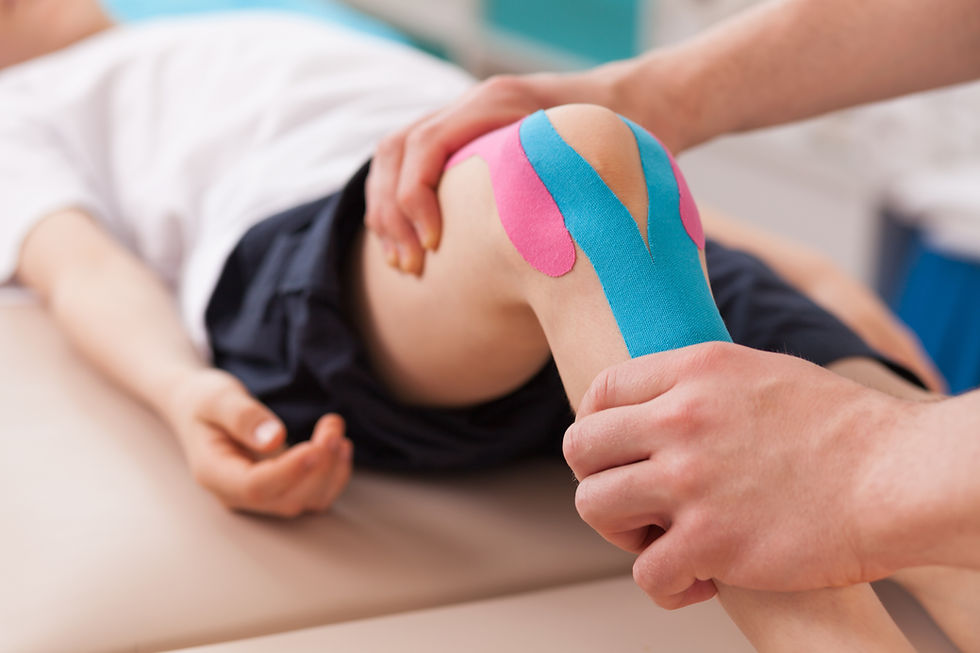
Support Your Recovery, Enhance Your Movement
You’ve likely seen athletes wearing brightly coloured tape, but therapeutic taping is a powerful tool for everyone—not just for sports. At ACE Physio Centre, our expert therapists use specific taping techniques as an integral part of your treatment plan to reduce pain, support injured tissues, and help you move with more confidence.
What Is Physiotherapy and Taping?
“Taping” in physiotherapy refers to the expert application of specialised tape to your body to achieve a specific therapeutic goal. It is not a standalone treatment, but a tool our physiotherapists use to support your overall rehabilitation.
There are two main types of taping we use:
Rigid Strapping Tape
This is a strong, non-elastic tape. Its primary role is to provide firm support and restrict movement. It is commonly used to protect an injured joint—such as a newly sprained ankle—or to correct joint positioning so tissues can heal safely.
Elastic Kinesiology Tape (K-Tape)
This is the flexible, stretchy tape often seen in bright colours. Rather than restricting movement, K-Tape works by providing sensory feedback to the nervous system. It can help reduce pain, improve muscle activation, and assist fluid drainage (swelling), all while allowing natural movement.
Why Choose ACE Physio Centre for Physiotherapy and Taping?
Taping is much more than simply applying tape—it is only effective when applied for the right reason and in the right way.
Expert Diagnosis
Anyone can apply tape, but only a physiotherapist understands why it’s needed. Every taping application begins with a thorough assessment to identify the root cause of your pain or dysfunction.
A Tool, Not a Crutch
We use taping as a temporary support to help you move comfortably while you rehabilitate. Our goal is to build strength, control, and confidence so that the tape is no longer needed.
Mastery of Technique
Our therapists have advanced knowledge of anatomy and biomechanics. We apply tape with the correct direction, tension, and technique to support ligaments, activate muscles, or offload stressed tissues effectively.
Integrated Approach
Taping is only one part of your one-on-one physiotherapy session. It works alongside hands-on manual therapy and a personalised exercise program to support faster and more complete recovery.
Common Conditions We Treat with Taping
Based on your assessment, taping may be used to:
Support acute joint injuries such as ankle, knee, or wrist sprains
Relieve pain by offloading sore muscles and tendons (e.g., Tennis Elbow, rotator cuff issues, plantar fasciitis)
Manage swelling and bruising after injury
Improve posture by providing sensory feedback for better alignment
Activate weak muscles (such as glutes) or relax overworked, tight muscles
Your Questions Answered
How long does the treatment last?
The shockwave portion of the treatment is surprisingly fast. A typical session involves delivering a set number of sound pulses to the injured area, which usually takes between 5 and 10 minutes.
How many sessions will I need?
While some patients feel relief after just one session, a full course is needed for lasting tissue repair. Evidence-based protocols typically involve 3 to 5 treatment sessions, spaced about one week apart. Your physiotherapist will recommend a plan based on your condition.
Does the treatment hurt?
You may feel some discomfort during treatment, especially over sensitive areas. Most patients describe it as manageable. The good news is that the treatment is brief, and any discomfort stops immediately once the session ends.